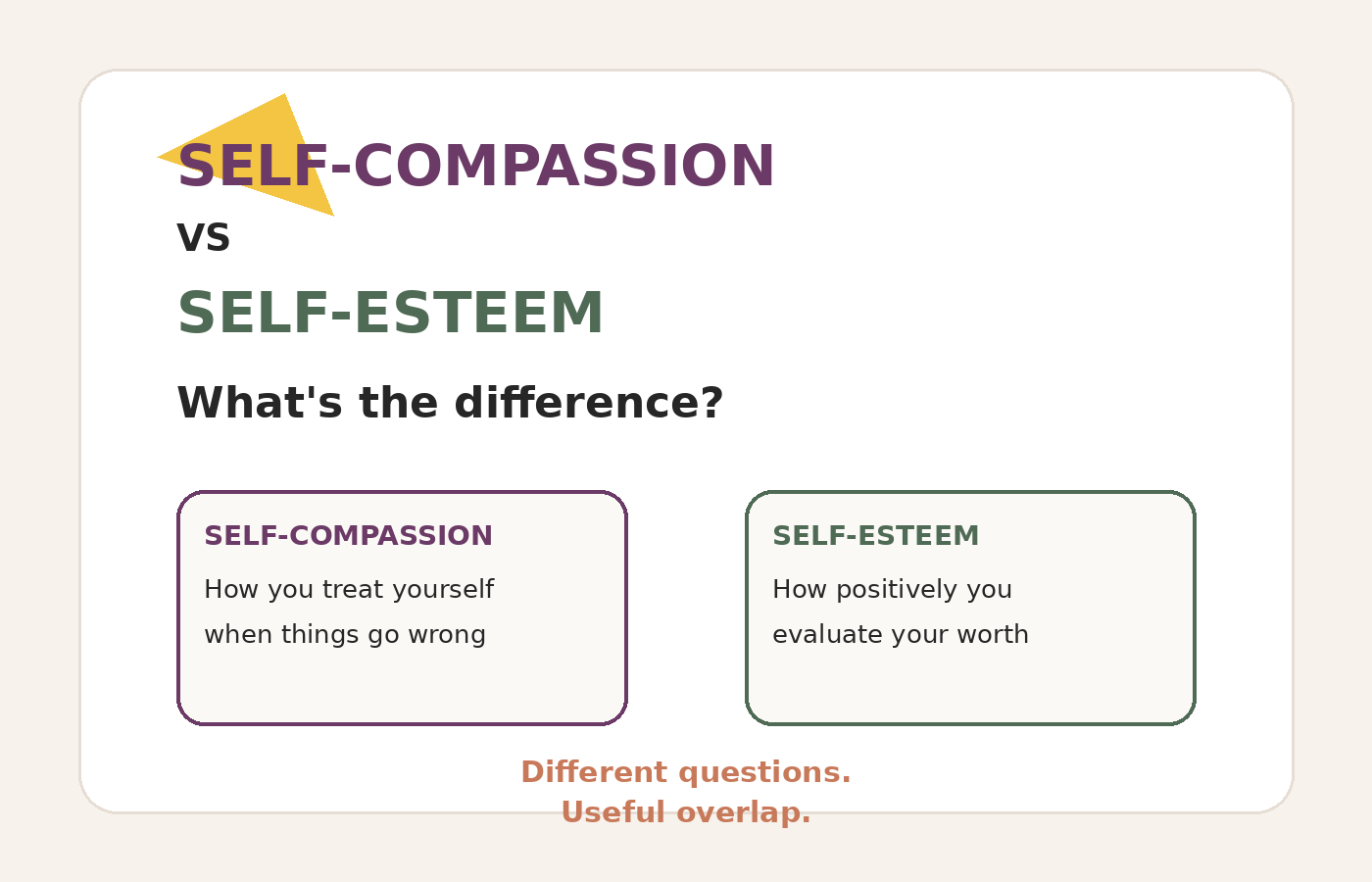
Self-compassion and self-esteem both shape how you relate to yourself, but they are not the same thing. Self-esteem is mainly about how positively you evaluate yourself and your worth. Self-compassion is about how you respond to yourself when you are struggling, failing, or feeling inadequate.
That difference matters most on difficult days. When things are going well, both can support a healthier sense of self. When you make a mistake, receive criticism, or feel rejected, self-compassion asks you to respond with care rather than attack yourself. Self-esteem asks how that event affects the way you see yourself overall.
Research suggests the two concepts overlap strongly, yet each also contributes something distinct. [1] This guide explains the difference, where they overlap, and how to strengthen both without turning your self-worth into another performance test.
Self-compassion vs self-esteem: the quick difference
The simplest distinction is this:
- Self-esteem: “How positively do I evaluate myself?”
- Self-compassion: “How do I treat myself when I am having a hard time?”
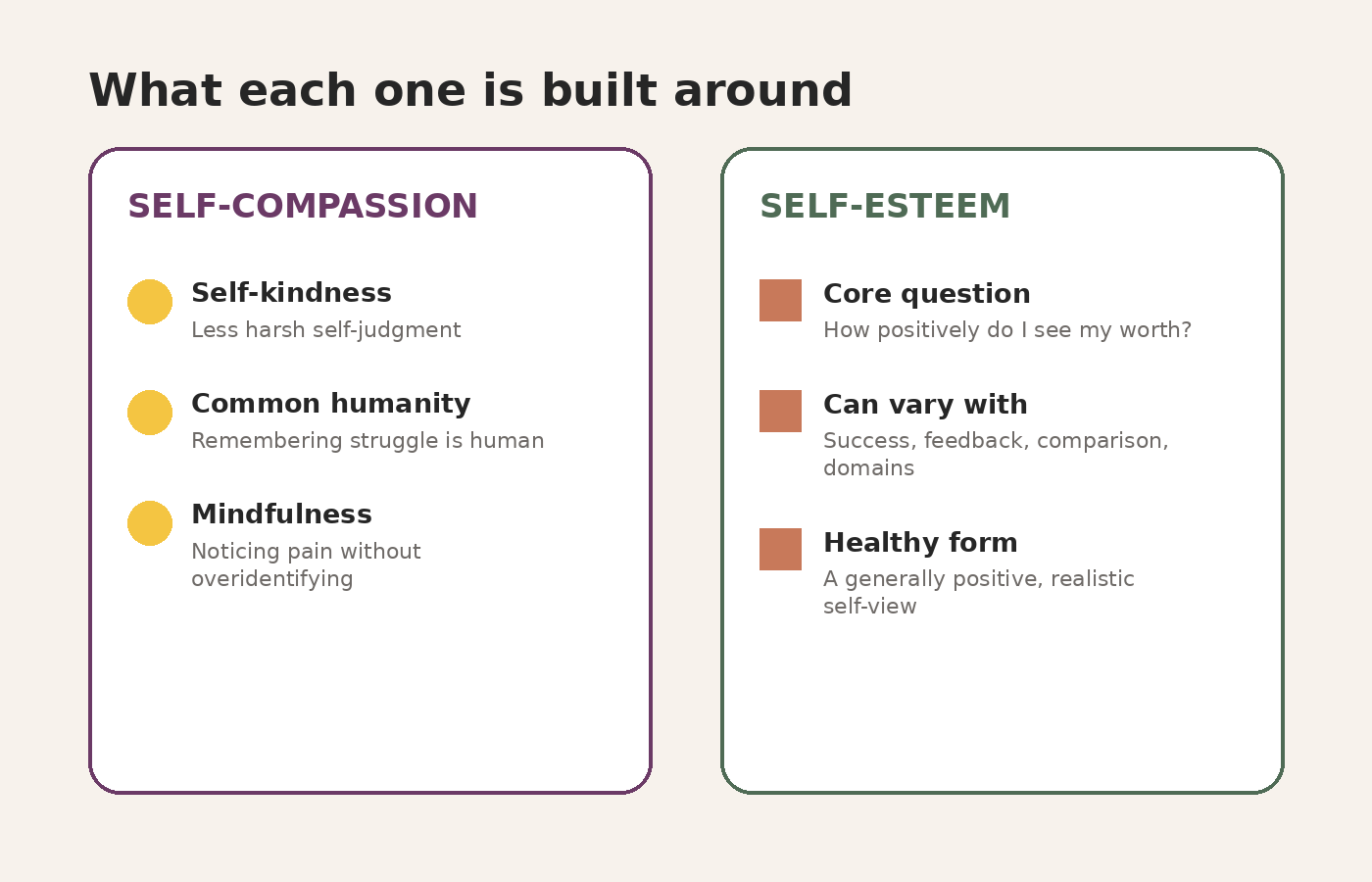
The American Psychological Association defines self-esteem as the degree to which the qualities in your self-concept are viewed positively. It can include how you see your abilities, accomplishments, values, appearance, and the way other people respond to you. [2]
Self-compassion is usually described as a supportive way of relating to yourself during pain, failure, or difficulty. In Kristin Neff’s widely used model, it includes self-kindness, a sense of common humanity, and mindful awareness rather than harsh judgment, isolation, and overidentification with distress. [3]
| Self-Compassion | Self-Esteem |
|---|---|
| Focuses on how you respond to yourself in difficulty | Focuses on how positively or negatively you evaluate yourself |
| Can be practiced even when you feel disappointed in yourself | Often reflects your broader sense of worth and self-regard |
| Emphasizes kindness, common humanity, and mindfulness | Emphasizes positive self-evaluation and self-acceptance |
| Does not require you to feel above average | Can sometimes be influenced by success, feedback, or comparison |
| Most visible when you fail, hurt, or struggle | Visible in how you generally think and feel about yourself |
What is self-esteem?
Self-esteem is your overall evaluation of yourself. It reflects the degree to which you see yourself in a positive, accepting, and worthwhile way. Healthy self-esteem does not require believing that you are better than everyone else. It can look much quieter: “I have strengths and weaknesses, and I still see myself as a person of value.”
Self-esteem can be relatively stable, but it can also fluctuate. Feedback, achievement, rejection, appearance concerns, relationship experiences, and progress toward personal goals can affect how some people feel about themselves. Psychologists distinguish a person’s general level of self-esteem from its stability, meaning how much it rises and falls in response to events. [4]
That helps explain why two people with similarly positive self-views may react differently to criticism. One may think, “I did poorly this time, but that does not change my overall worth.” Another may feel temporarily confident only while receiving praise or succeeding.
What is self-compassion?
Self-compassion is a way of responding to yourself when you are hurting. It does not require you to decide that you performed well or that your mistake was unimportant. You can admit that something went badly and still choose not to treat yourself cruelly.
Neff’s model describes three paired elements: self-kindness rather than self-judgment, common humanity rather than isolation, and mindfulness rather than becoming completely consumed by difficult thoughts and feelings. [3]
For example, after making a mistake, self-compassion might sound like this:
“I am disappointed, and I need to take responsibility. I can do that without calling myself useless. Other people make painful mistakes too. I can look clearly at what happened and decide what to do next.”
That response is not about lowering standards. It separates accountability from self-attack.
The biggest differences between self-compassion and self-esteem
1. One is an evaluation; the other is a response
Self-esteem answers a judgment question: How do I see myself? Self-compassion answers a relationship question: How do I respond to myself when I am suffering?
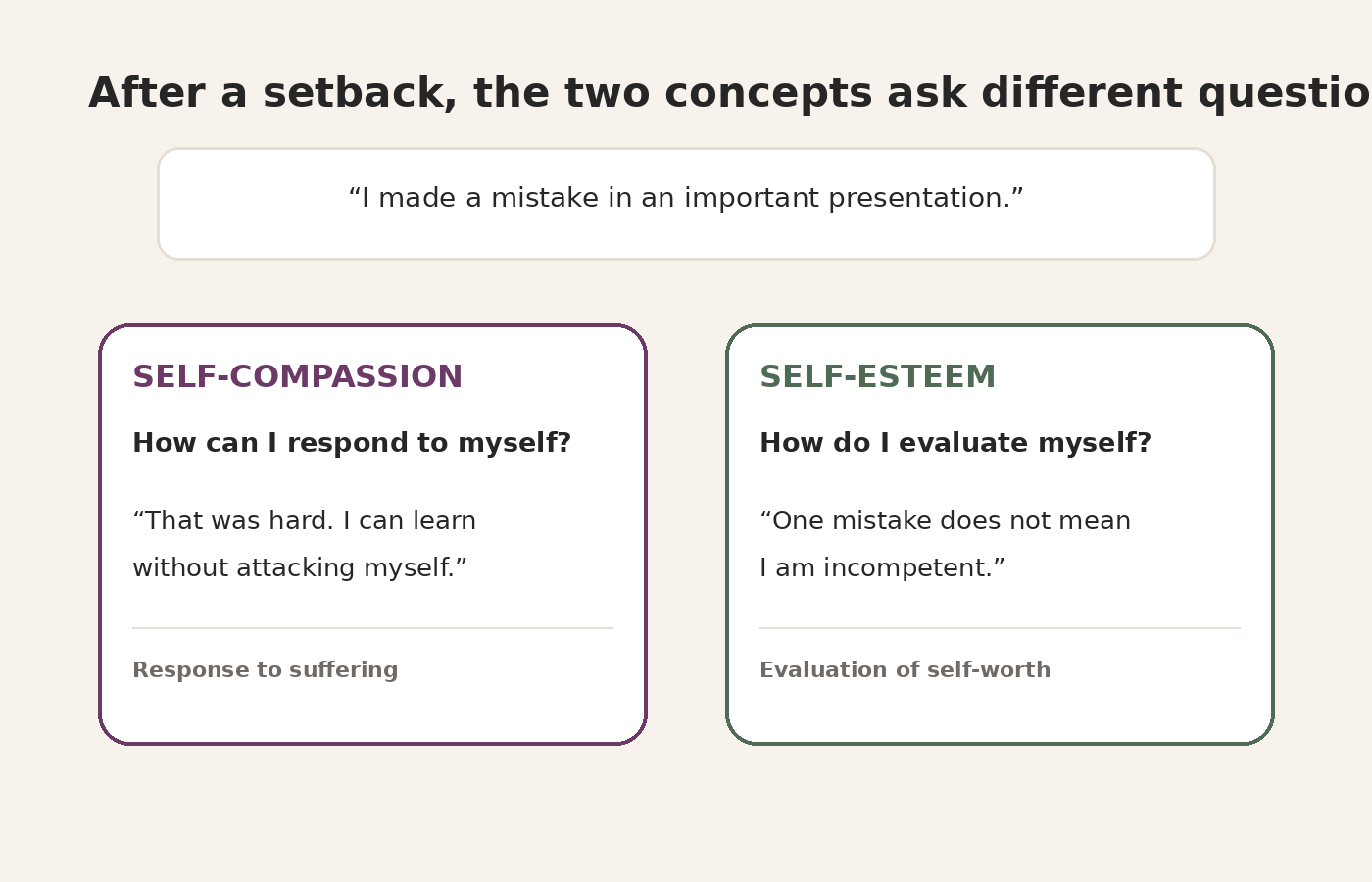
You can see the distinction after a setback. Imagine that you give an important presentation and lose your train of thought.
A self-esteem response might challenge the conclusion, “I am incompetent,” by remembering your overall ability and previous successes. A self-compassion response might say, “That was embarrassing and disappointing. I can be kind to myself while I work out what to improve.”
Both responses can be useful, but they are doing different jobs.
2. Self-compassion does not depend on feeling successful
Self-esteem can remain healthy through failure, especially when it is stable and not tightly tied to one achievement. Still, some forms of self-esteem become contingent on doing well, receiving approval, looking a certain way, or comparing favorably with other people.
Self-compassion does not require a positive performance evaluation first. In fact, it becomes most relevant when you have failed, been rejected, or noticed something about yourself that you do not like.
In a 2009 study comparing the two constructs, self-compassion was associated with more stable feelings of self-worth and was less contingent on particular outcomes than self-esteem. It was also more strongly negatively related to social comparison and self-rumination in that study. [5]
That does not mean healthy self-esteem is bad or that everyone with high self-esteem depends on comparison. It means self-compassion offers another route to a healthy relationship with yourself when there is nothing impressive to point to.
3. Self-esteem can change with the story you tell about yourself
Self-esteem often reflects conclusions such as “I am capable,” “I am lovable,” or “I am not good enough.” Those conclusions can become more positive or negative as experiences accumulate.
Self-compassion does not require rewriting every negative thought into a positive one. It asks you to notice the pain and respond in a less hostile way.
For example, after a breakup, you may not genuinely believe, “I feel confident and desirable.” A self-compassionate response can be more believable: “I feel rejected right now, and that hurts. I do not need to turn this feeling into proof that something is wrong with me.”
4. Self-compassion includes a sense of shared humanity
Self-esteem is mainly concerned with your evaluation of yourself. Self-compassion adds another idea: difficulty, failure, and imperfection are part of being human.
This is not the same as dismissing your experience with “everyone has problems.” Common humanity is meant to reduce the isolating belief that you are uniquely defective because you struggle.
If you fail an exam, common humanity does not say the result does not matter. It says you are not the only person who has fallen short of a goal, and one difficult result does not remove you from the rest of humanity.
5. The two concepts overlap more than they compete
It is easy to frame self-compassion and self-esteem as alternatives, but the research picture is more balanced. A 2023 review and meta-analysis covering 76 studies and 35,537 participants found a strong average correlation between self-esteem and self-compassion. Both were similarly related to measures of well-being and psychological problems, while each also explained some unique variation after their shared overlap was considered. The authors described them as complementary concepts. [1]
So the practical question is usually not, “Which one should I have?” A more useful question is, “What do I need in this moment: a more balanced view of my worth, a kinder response to my pain, or both?”
Can you have high self-esteem but low self-compassion?
Yes. Someone can generally think highly of themselves yet become extremely harsh when they fail.
For example, a person may see themselves as intelligent, successful, and competent. When they make an error at work, however, they may spend hours calling themselves careless, hiding the mistake, or feeling unable to tolerate being imperfect. Their self-esteem may be fairly positive overall, while their response to suffering lacks self-compassion.
This distinction can be especially useful for people who feel confident as long as they are performing well but become intensely self-critical when their usual strengths are challenged.
Can you practice self-compassion when your self-esteem is low?
Yes. You do not have to wait until you feel good about yourself before responding to yourself with care.
If you are thinking, “I do not like myself very much right now,” self-compassion does not force you to replace it with “I am amazing.” You could start with something more grounded:
“I am having a hard time seeing myself kindly today. I do not need to make that harder by attacking myself.”
This is one reason self-compassion can be practical during setbacks. It does not depend on producing a strong positive self-evaluation before you are allowed to care for yourself.
Is self-compassion better than self-esteem?
Research does not support treating the two as a simple winner-and-loser comparison. They are strongly related, they each have distinct features, and both have been associated with psychological well-being. [1]
Some findings highlight advantages of self-compassion in situations involving failure or comparison. In Neff and Vonk’s 2009 study, self-compassion was less contingent on outcomes and less connected with social comparison than self-esteem. The same research found self-esteem, but not self-compassion, was positively associated with narcissism in that sample. [5]
That result should not be turned into “high self-esteem causes narcissism.” Self-esteem and narcissism are different constructs, and healthy self-esteem can include realistic self-respect without superiority or entitlement.
A later meta-analysis found self-esteem and self-compassion were strongly related and had broadly similar associations with well-being and psychological problems. [1] For everyday personal growth, it makes sense to strengthen a stable sense of worth while also learning how to treat yourself when that sense of worth feels threatened.
How to strengthen self-compassion and self-esteem together
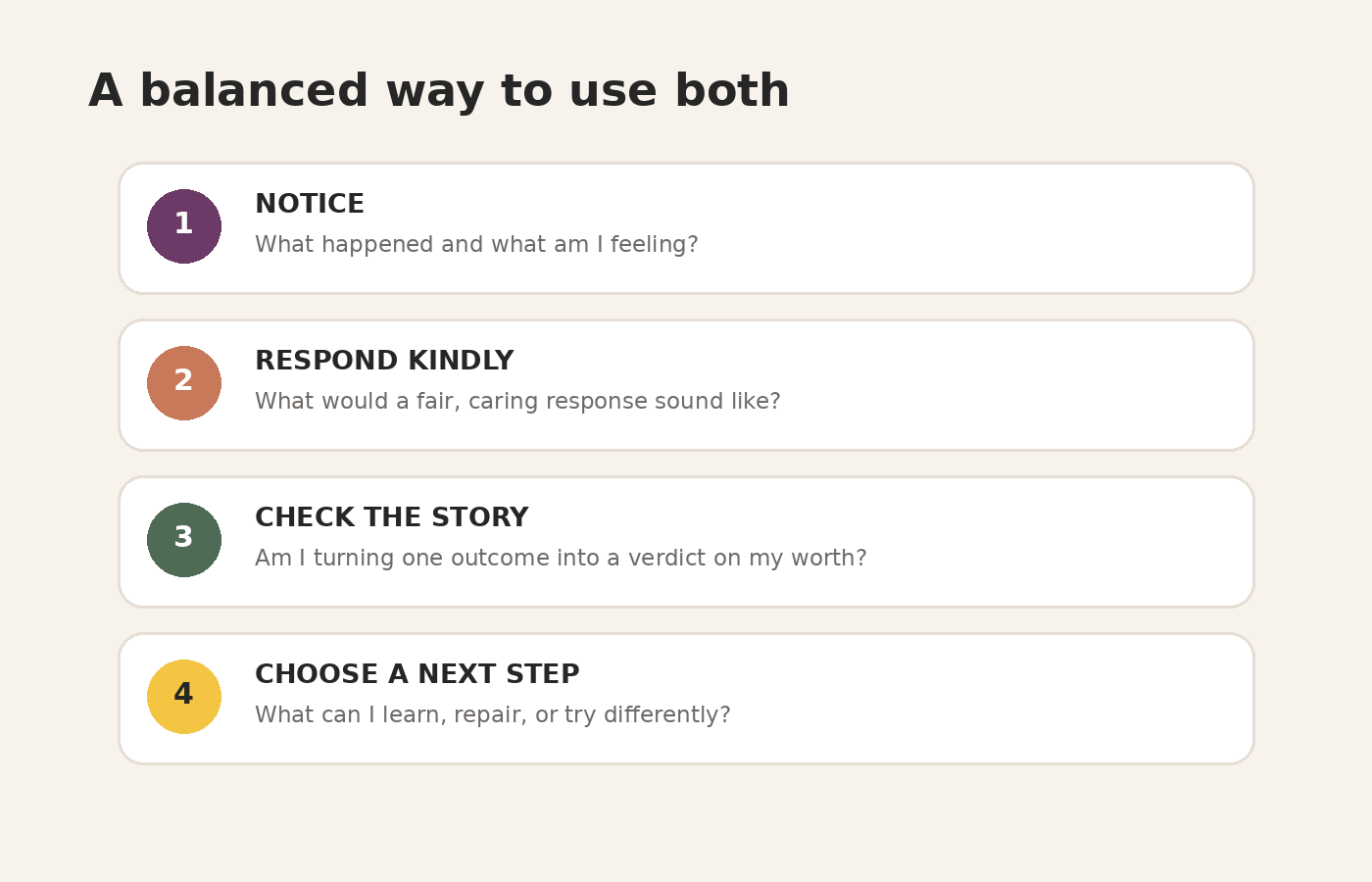
You do not need separate routines for each. A single difficult moment can become practice for both.
Notice what happened before judging yourself
Describe the event in concrete terms. “I forgot an important deadline” is more useful than “I am hopeless.” The first statement describes a problem. The second turns the problem into an identity.
Respond to the pain before trying to fix your self-image
If you are embarrassed, rejected, or disappointed, name that first. Try: “This hurts,” or “I am disappointed in myself.” Then add a fair response rather than jumping immediately to reassurance.
This is where self-compassion comes in: “I can take this seriously without tearing myself apart.”
Check the conclusion you are making about your worth
Ask, “Am I treating one outcome as proof of who I am?” A mistake can contain useful information without becoming a verdict on your entire value.
If your self-esteem has taken a hit, look for a balanced view rather than exaggerated praise. “I handled this poorly” can coexist with “I am still a person with strengths, value, and the ability to improve.”
Choose one responsible next step
Self-kindness is easier to trust when it includes action. Apologize if needed. Ask for feedback. Practice the skill. Rest if you are overwhelmed. Set a boundary if someone else’s criticism is unfair.
Compassion-based interventions may also improve self-esteem, according to a 2021 systematic review and meta-analysis, although the authors noted considerable differences between the included studies and advised caution in drawing broad conclusions. [6]
A quick example: criticism at work
Imagine your manager says your report was unclear and needs to be rewritten.
A low-self-esteem reaction might be: “I knew I was not good enough for this role.”
A harsh response with otherwise decent self-esteem might be: “I am usually good at this. I cannot believe I messed up. I am such an idiot.”
A more balanced response using both concepts might be: “I am disappointed because I care about doing good work. One unclear report does not define my competence. I can ask which sections caused confusion and improve the next version without insulting myself.”
The final response protects self-worth, makes room for disappointment, and keeps responsibility intact.
Frequently Asked Questions
Is self-compassion the same as self-pity?
No. Self-compassion includes recognizing pain while also remembering that difficulty is part of the human experience. Self-pity is more likely to become narrowly focused on “why this is happening to me.” In the self-compassion model, common humanity and mindful awareness are meant to reduce isolation and overidentification with distress. [3]
Does self-compassion make you lazy or less motivated?
Self-compassion does not require lowering your standards or excusing behavior. A major research review describes self-compassion as compatible with motivation and discusses evidence challenging the idea that it is inherently weak, selfish, or self-indulgent. [3] In practice, the useful test is simple: does your kinder response help you face the problem and choose a responsible next step?
Can high self-esteem be unhealthy?
A positive sense of self-worth is not inherently unhealthy. Problems are more likely when self-worth is unstable, depends heavily on certain outcomes, or becomes tied to superiority and constant comparison. High self-esteem itself should not be confused with narcissism. Healthy self-esteem can be realistic, stable, and respectful of other people’s worth.
Does improving self-compassion raise self-esteem?
It may. A systematic review and meta-analysis of compassion-focused and compassion-based interventions found improvements in self-esteem across the included studies, but the studies varied considerably in design and quality. [6] It is more accurate to say self-compassion can support a healthier self-relationship than to promise that it will automatically raise self-esteem.
You can value yourself and be kind to yourself
Self-esteem gives you a way to understand how you value and evaluate yourself. Self-compassion gives you a way to stay on your own side when life exposes your limits, mistakes, or pain.
You do not need to choose between them. A steadier goal is to build a realistic sense of self-worth while practicing a response that does not disappear the moment you fall short.
Sources
- Muris, P., & Otgaar, H. (2023). Self-Esteem and Self-Compassion: A Narrative Review and Meta-Analysis on Their Links to Psychological Problems and Well-Being. Psychology Research and Behavior Management, 16, 2961-2975.
- American Psychological Association. APA Dictionary of Psychology: Self-esteem.
- Neff, K. D. (2023). Self-Compassion: Theory, Method, Research, and Intervention. Annual Review of Psychology, 74, 193-218.
- American Psychological Association. APA Dictionary of Psychology: Self-esteem stability.
- Neff, K. D., & Vonk, R. (2009). Self-compassion versus global self-esteem: two different ways of relating to oneself. Journal of Personality, 77(1), 23-50.
- Thomason, S., & Moghaddam, N. (2021). Compassion-focused therapies for self-esteem: A systematic review and meta-analysis. Psychology and Psychotherapy, 94(3), 737-759.