Positive thinking can be helpful. The problem starts when positivity becomes a rule that leaves no room for disappointment, grief, anger, fear, or uncertainty.
Toxic positivity is a term used for pressure to stay positive in situations where difficult emotions are understandable and need space. A recent scoping review described it as an overgeneralized expectation of positivity that can involve emotional invalidation, suppression, unrealistic optimism, and pressure to appear happy. [1]
Often, the person saying the positive phrase is trying to help. The impact can still feel dismissive. The examples below show 10 common forms of toxic positivity and what to say instead so support can feel more honest, validating, and useful.
What makes positivity “toxic”?
Positivity itself is not the problem. Hope, encouragement, gratitude, and optimism can all be supportive. Positivity becomes unhelpful when it pressures someone to hide, minimize, or quickly replace a difficult emotion rather than acknowledge it.
Psychology research often discusses a related concept called emotional invalidation: responses that reject, minimize, or communicate that a person’s emotional experience is wrong or unacceptable. Studies have linked perceived emotional invalidation with greater emotional distress and emotion-regulation difficulties. [2]
Validation does not mean agreeing with every interpretation or telling someone they should stay upset. It means recognizing that their emotion makes sense in context before trying to solve the problem or shift perspective.
10 examples of toxic positivity and what to say instead
1. “Just stay positive.”
This sounds encouraging, but it can imply that feeling sad, worried, or disappointed is a failure of attitude.
If someone has just lost a job, ended a relationship, or received difficult news, they may not need an instruction to think positively. They may first need permission to admit that the situation hurts.
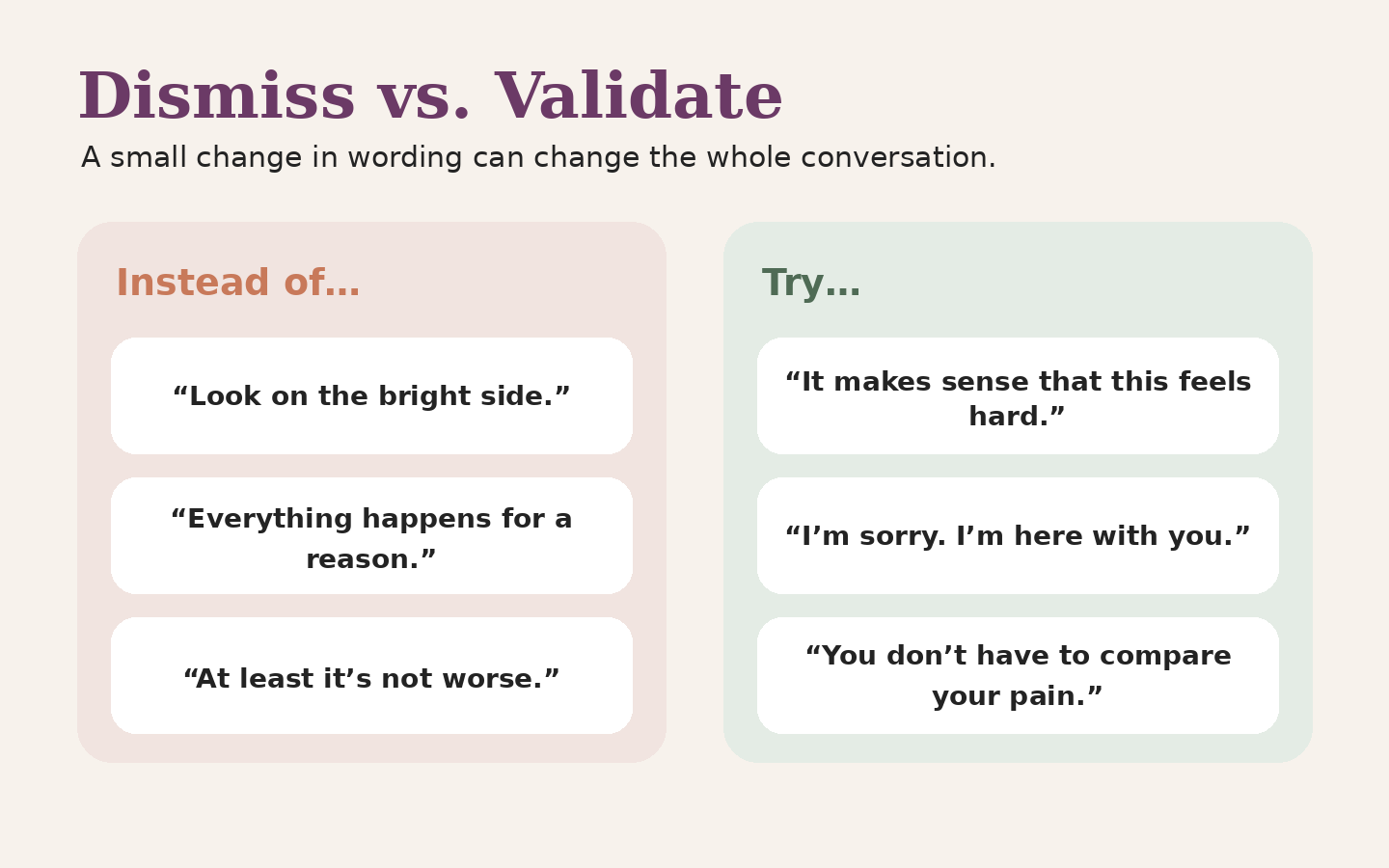
What to say instead: “That sounds really hard. You do not have to pretend you are okay with me.”
This response leaves room for the feeling without assuming the person will always feel this way.
2. “Everything happens for a reason.”
Some people find this belief comforting, especially when it reflects their own values or worldview. It becomes dismissive when it is imposed on someone who is grieving, confused, or trying to make sense of something painful.
The phrase can shift the conversation away from the person’s experience and toward finding an explanation before they are ready.
What to say instead: “I am sorry you are going through this. I do not have an explanation, but I am here with you.”
You do not need to explain pain in order to acknowledge it.
3. “At least it could be worse.”
Comparison can create perspective, but using a worse situation to cancel someone’s current pain rarely feels supportive.
A person can know that others have bigger problems and still be genuinely struggling. Two things can be true at once: their situation may not be the worst possible outcome, and it can still hurt.
What to say instead: “You do not have to compare this with someone else’s pain. It is understandable that this is affecting you.”
4. “Other people have it much harder.”
This is similar to “it could be worse,” but it adds guilt. The person may start feeling ashamed for having an emotion at all.
Imagine someone saying they feel overwhelmed after caring for a family member for months. Responding that other caregivers have harder circumstances does not reduce the exhaustion in front of you.
What to say instead: “You have been carrying a lot. What has been the hardest part lately?”
A question like this invites the person to explain rather than defend their feelings.
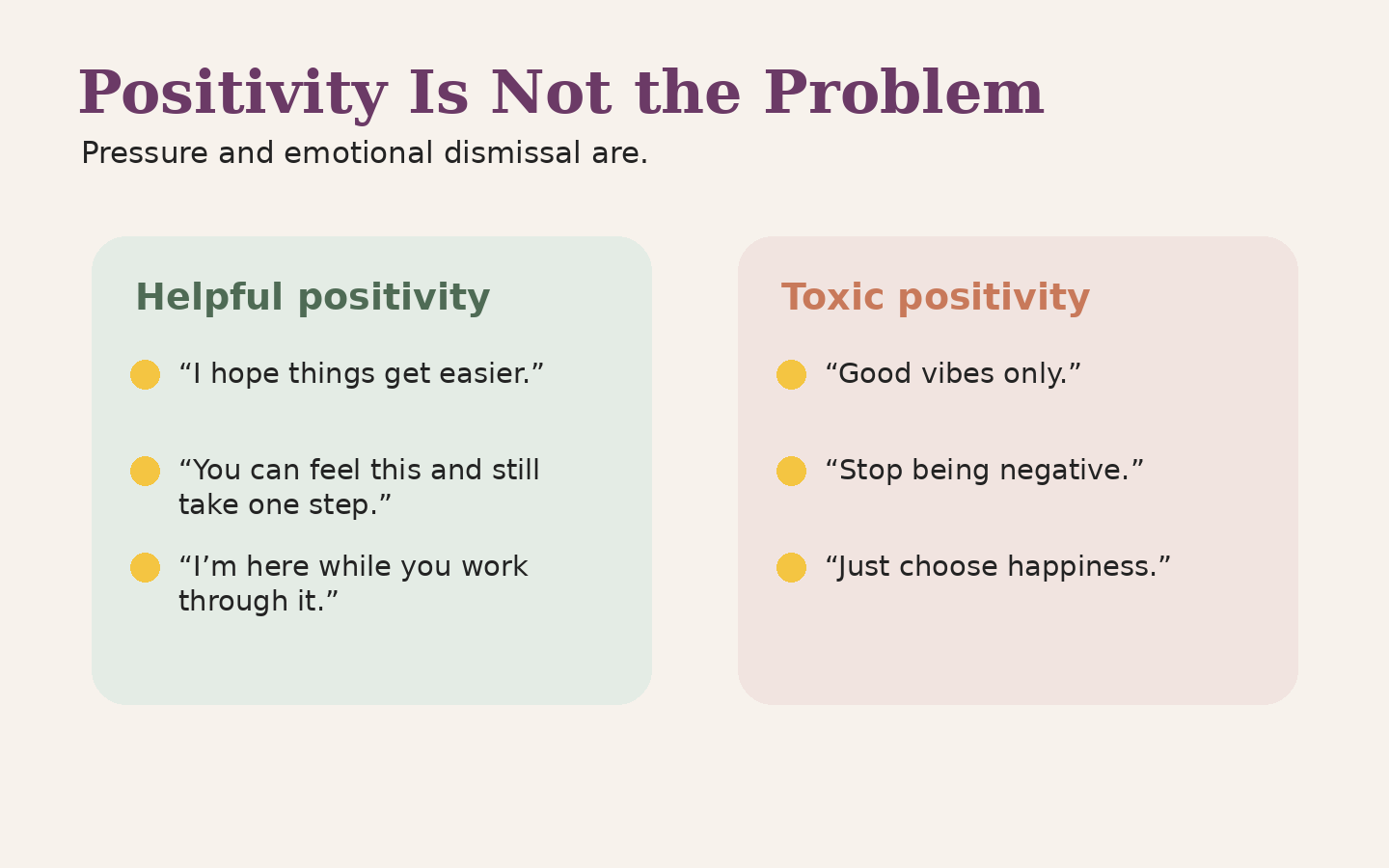
5. “Good vibes only.”
As a playful slogan, this may be harmless. As a rule in a friendship, family, or workplace, it can communicate that uncomfortable emotions are unwelcome.
Healthy relationships need room for more than pleasant feelings. People sometimes need to express frustration, disappointment, uncertainty, or sadness without being treated as a source of negativity.
What to say instead: “You can be honest about how you feel here.”
That does not mean every conversation has to become heavy. It simply tells the person that they do not need to perform happiness to remain welcome.
6. “Stop being so negative.”
Calling someone “negative” can turn a temporary emotional state into a judgment about their personality.
Sometimes repeated complaining does need a boundary. But there is a difference between setting a limit and dismissing the emotion itself.
What to say instead: “I can hear how frustrated you are. Do you want me to listen, or would it help to think through what you can do next?”
This validates the emotion while giving the conversation direction.
7. “You will get over it.”
The intention may be to reassure someone that the pain will not last forever. The problem is that the phrase can sound impatient, especially when the loss or disappointment is recent.
People do not all move through grief, rejection, or major change on the same timeline. Predicting when someone should be “over it” can create pressure to recover on schedule.
What to say instead: “I know this is still painful. I am here while you work through it.”
You can offer hope without assigning a deadline.
8. “Just be grateful for what you have.”
Gratitude can be meaningful, but gratitude and pain are not opposites. Someone can appreciate their family, home, health, or opportunities and still feel disappointed about something specific.
When gratitude is used to shut down another emotion, it becomes a demand rather than a helpful practice.
What to say instead: “You can appreciate what is going well and still be upset about this.”
This makes room for mixed emotions, which are common in real life.
9. “Look on the bright side.”
Looking for a helpful perspective can be useful after someone feels heard. It is less helpful when it arrives before their experience has even been acknowledged.
If a person says they are disappointed after being rejected for a job, immediately listing the advantages of not getting it may feel like skipping over what the opportunity meant to them.
What to say instead: “I know you really wanted this. Would it help if I listened for a bit, or do you want to look at what comes next?”
Notice the order: acknowledgment first, problem-solving second.
10. “Happiness is a choice.”
People can make choices that support well-being, but emotions are not simple switches. Telling someone to choose happiness can suggest that their sadness, fear, or distress exists because they are making the wrong decision.
That can be especially unhelpful when the person is dealing with grief, prolonged stress, or a mental-health difficulty.
What to say instead: “You do not have to force yourself to feel differently right now. What would feel supportive today?”
This leaves room for agency without demanding a particular emotion.
What does emotional validation sound like?
Validation usually starts with understanding before advice. In experimental research, validating responses have been associated with changes in emotional reactions, while invalidating responses can intensify negative emotion in some contexts. The effect is not identical for every emotion or every person, which is another reason to listen rather than rely on a single perfect phrase. [3]
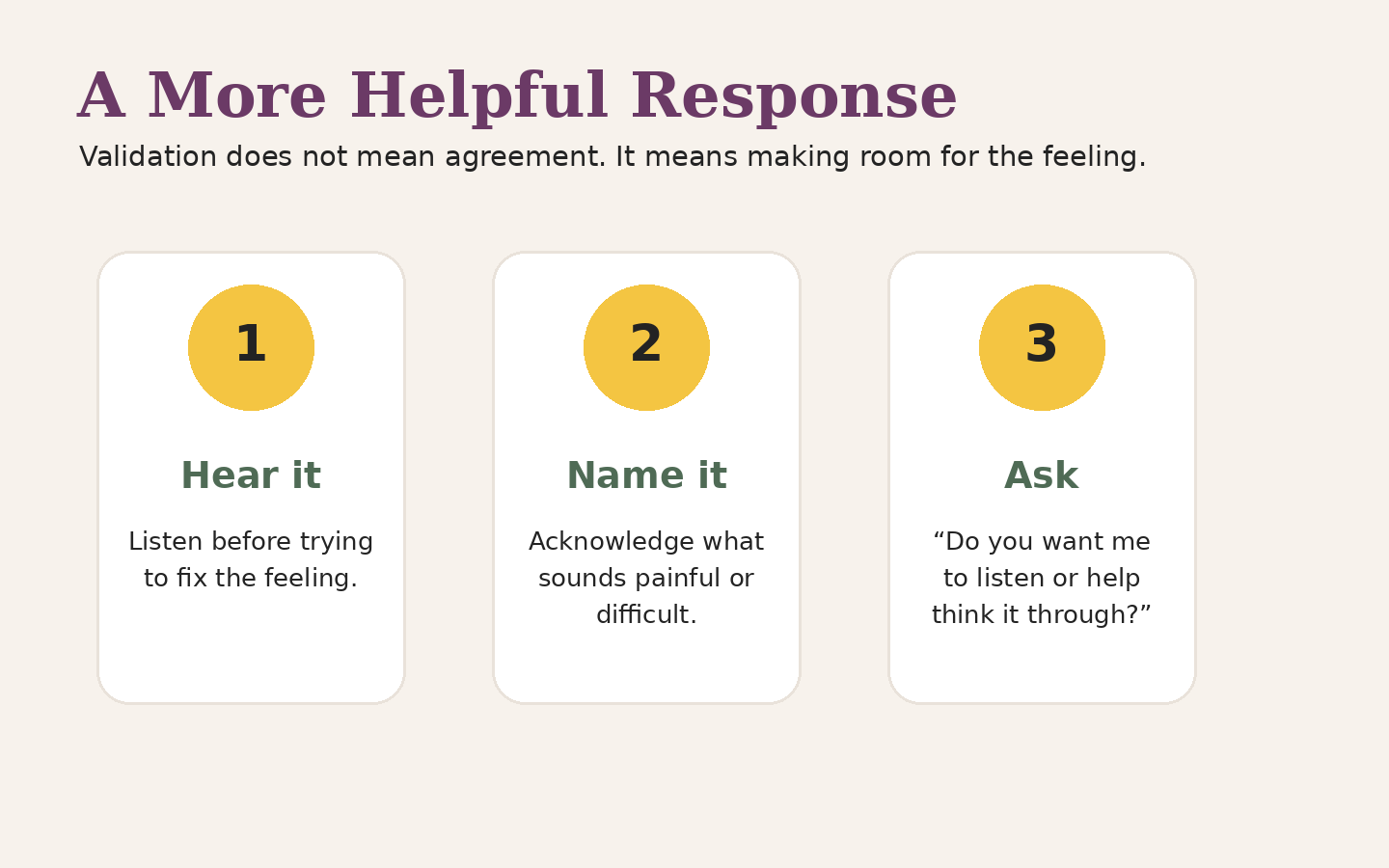
A simple response can follow three steps:
- Hear it: Let the person finish before trying to fix the situation.
- Name it: “That sounds disappointing,” “You seem exhausted,” or “I can see why that hurt.”
- Ask what helps: “Do you want me to listen, help you think it through, or give you some space?”
You do not have to agree with every conclusion to validate the feeling. You might say, “I can understand why you felt hurt by that,” even if you see part of the situation differently.
How to be encouraging without dismissing difficult feelings
Support does not require choosing between empathy and hope. You can acknowledge the difficult part first and still offer encouragement.
For example:
- Instead of “You have got this,” try: “This is a lot, and I believe you can take it one step at a time.”
- Instead of “Do not worry,” try: “I can see why you are worried. Is there anything practical we can do?”
- Instead of “Think positive,” try: “We do not have to solve everything right now. What would make today a little easier?”
The positive part is still there. The difference is that it does not require the difficult emotion to disappear first.
What if you catch yourself using toxic positivity?
You do not need to turn it into another reason to criticize yourself. Many common phrases come from a genuine wish to comfort someone, and habits can change once you notice them.
If you realize you dismissed someone’s feelings, you can simply repair it:
“I think I rushed into trying to make you feel better. I am sorry. What you are dealing with sounds difficult. Do you want to tell me more?”
That kind of correction can be more useful than trying to say the perfect thing every time.
Frequently Asked Questions
Is toxic positivity a mental-health diagnosis?
No. Toxic positivity is not a formal mental-health diagnosis. It is a descriptive term used for patterns in which positivity becomes excessive, socially enforced, or emotionally invalidating. Research on the concept is still developing, and a recent scoping review noted that there is limited empirical research and no single universally established definition or measurement approach. [1]
Is saying “everything will be okay” toxic positivity?
Not automatically. Context and timing matter. If the person already feels heard, reassurance may be comforting. If “everything will be okay” is used to stop them from expressing fear or sadness, it may feel invalidating. When unsure, acknowledge the emotion first and then offer hope.
Is it wrong to encourage someone to think positively?
No. Encouragement can be helpful when it does not deny the situation or pressure the person to perform a certain emotion. A more balanced response is often: acknowledge what is hard, then help the person notice options, strengths, or hope when they are ready.
What should I say when I genuinely do not know how to help?
You can be honest: “I do not know what to say, but I care about you and I am listening.” You can also ask, “What would feel most helpful right now?” Sometimes presence is more useful than advice.
Make room for the full emotional picture
Healthy positivity does not require sadness, anger, or fear to disappear. It can sit beside them.
When someone is struggling, the most useful response is often less complicated than it seems: hear what they are saying, acknowledge what feels hard, and ask what kind of support they want. Hope tends to land better when the person does not have to hide their real feelings to receive it.
Sources
- Conceptualising toxic positivity – definition, dimensions, antecedents and consequences: a scoping review of the literature. PubMed-indexed scoping review, 2026.
- Zielinski, M. J., et al. (2018). The Perceived Invalidation of Emotion Scale (PIES): Development and psychometric properties of a novel measure of current emotion invalidation. Psychological Assessment.
- Southward, M. W., et al. (2022). The who and what of validation: an experimental examination of validation and invalidation of specific emotions and the moderating effect of emotion dysregulation.