You can know that something is over and still feel pulled back into it. A breakup, an old mistake, a rejection, a painful conversation, or a missed opportunity can keep replaying long after the moment itself has passed.
Learning how to let go of the past does not mean pretending it did not matter. It means changing your relationship with the memory so it stops taking up more of your present than you want to give it. That may involve accepting what cannot be changed, repairing what still can be repaired, responding to yourself with more fairness, and putting attention back into the life you are living now.
The nine steps below are gentle on purpose. You do not need to force yourself to “move on” before you are ready.
What does letting go of the past actually mean?
Letting go is not forgetting, excusing harmful behavior, or deciding that what happened was acceptable. It is allowing the past to become part of your story without letting it direct every new decision.
One reason this can be difficult is rumination: repeated thinking about distressing events, feelings, or questions without reaching a useful next step. Research reviews have linked rumination with prolonged negative mood and poorer problem-solving, which helps explain why replaying the same event can feel active while leaving you no closer to resolution. [1]
Reflection can be useful when it leads to understanding, repair, or a decision. Rumination tends to circle. A helpful question is: “Is this thought helping me respond differently, or am I only replaying what I already know?”
How to let go of the past: 9 gentle steps
1. Name what you are still carrying
Start by getting specific. “I cannot let go of the past” is so broad that your mind has nothing clear to work with. Try naming the part that still has a hold on you.
You might be carrying regret about what you said, anger about how someone treated you, embarrassment about an old choice, or sadness about a relationship that ended. Two people can remember the same event and be stuck on completely different parts of it.
Use one sentence:
- “I keep replaying the way that friendship ended.”
- “I still feel ashamed of how I handled that conversation.”
- “I am angry that I never received an apology.”
Keep the sentence simple. You are identifying the issue, not writing the full history again. Once you know what you are carrying, the next step becomes easier to choose.
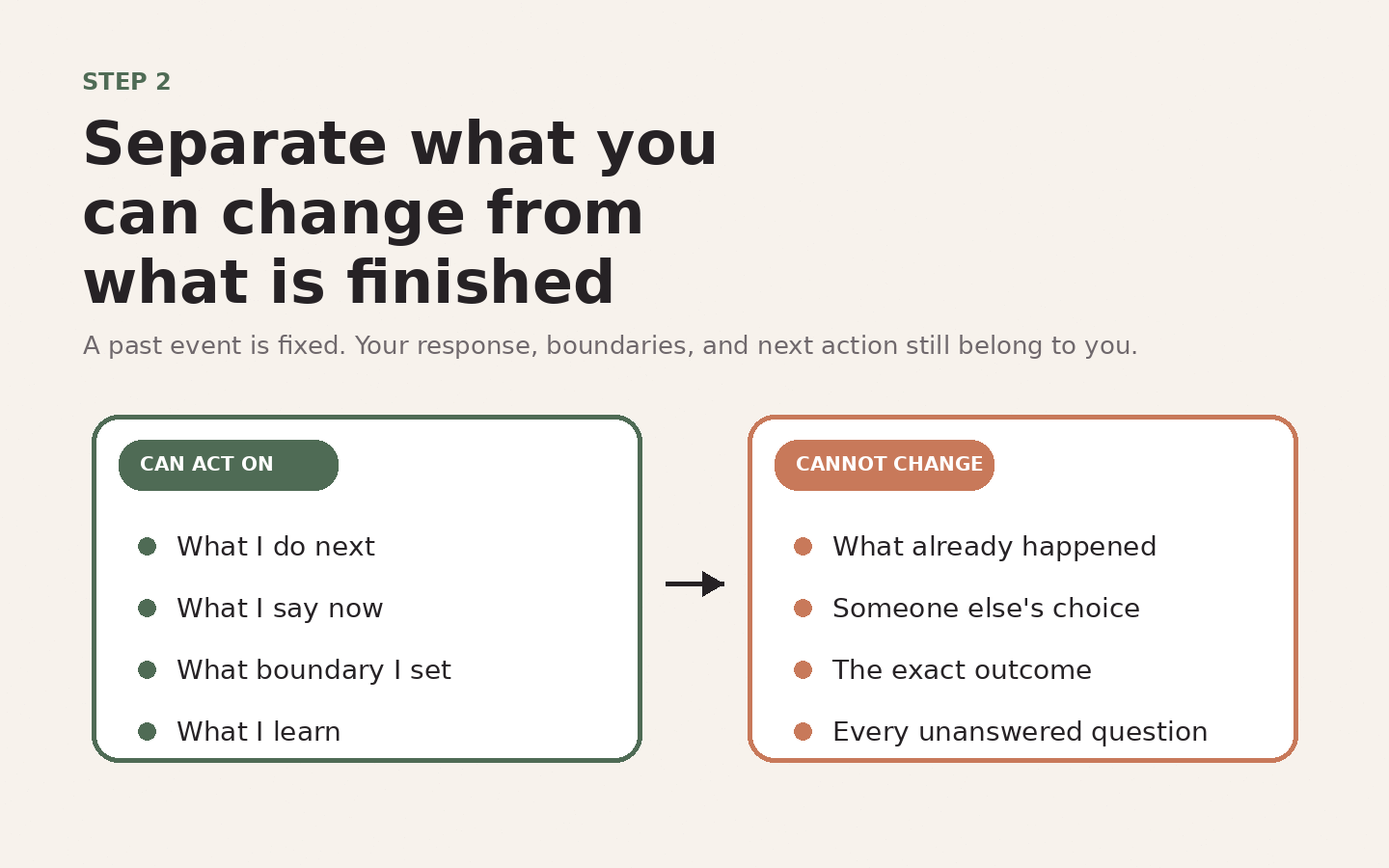
2. Separate what you can change from what is finished
A painful event can contain both fixed facts and unfinished business. Separating them prevents you from spending energy trying to solve something that no longer has a practical solution.
NHS problem-solving guidance recommends distinguishing problems that can be acted on from worries that are outside your control, including things that already happened in the past. [2]
Make two short lists. Under “I can act on”, you might write: apologize, ask a question, return something, set a boundary, or make a different choice next time. Under “I cannot change”, you might write: what was said, another person’s decision, the time that has passed, or the exact outcome you wish had happened.
This distinction does not make the fixed part painless. It simply stops you from treating it like an unfinished task.
3. Let the feeling exist without giving it the whole day
Trying to push away sadness, anger, or regret can turn the feeling itself into another struggle. Instead, give it a small amount of honest attention.
You might sit quietly for a few minutes and name what is present: “I feel hurt,” “I am disappointed,” or “I wish this had gone differently.” You do not have to explain the feeling, justify it, or make it disappear.
If thoughts keep taking over the day, a short scheduled period can help create some structure. NHS guidance on managing worry suggests writing concerns down and setting aside a limited time to think about them, then returning attention to the present when they appear outside that period. [3]
The goal is not to suppress the past. It is to give it a place rather than unlimited access to your attention.
4. Stop rehearsing alternate versions of what happened
“If only I had said something else.” “If only I had noticed sooner.” “If only I had made a different choice.” These thoughts can feel like problem-solving because they create new versions of the past. But a version that cannot be acted on will not become more useful through repetition.
When you catch an “if only” loop, ask two questions:
- Is there a lesson here that changes what I will do next time?
- Is there a real action available to me now?
If the answer is yes, write down the lesson or action. Then stop reopening the full scene. If the answer is no, label the thought for what it is: “I am replaying this again.”
That small shift can help you move from being inside the memory to noticing that the memory is happening in your mind right now. Approaches that build present-moment awareness, acceptance, and values-based action are central to psychological flexibility, a process studied within Acceptance and Commitment Therapy. [4]
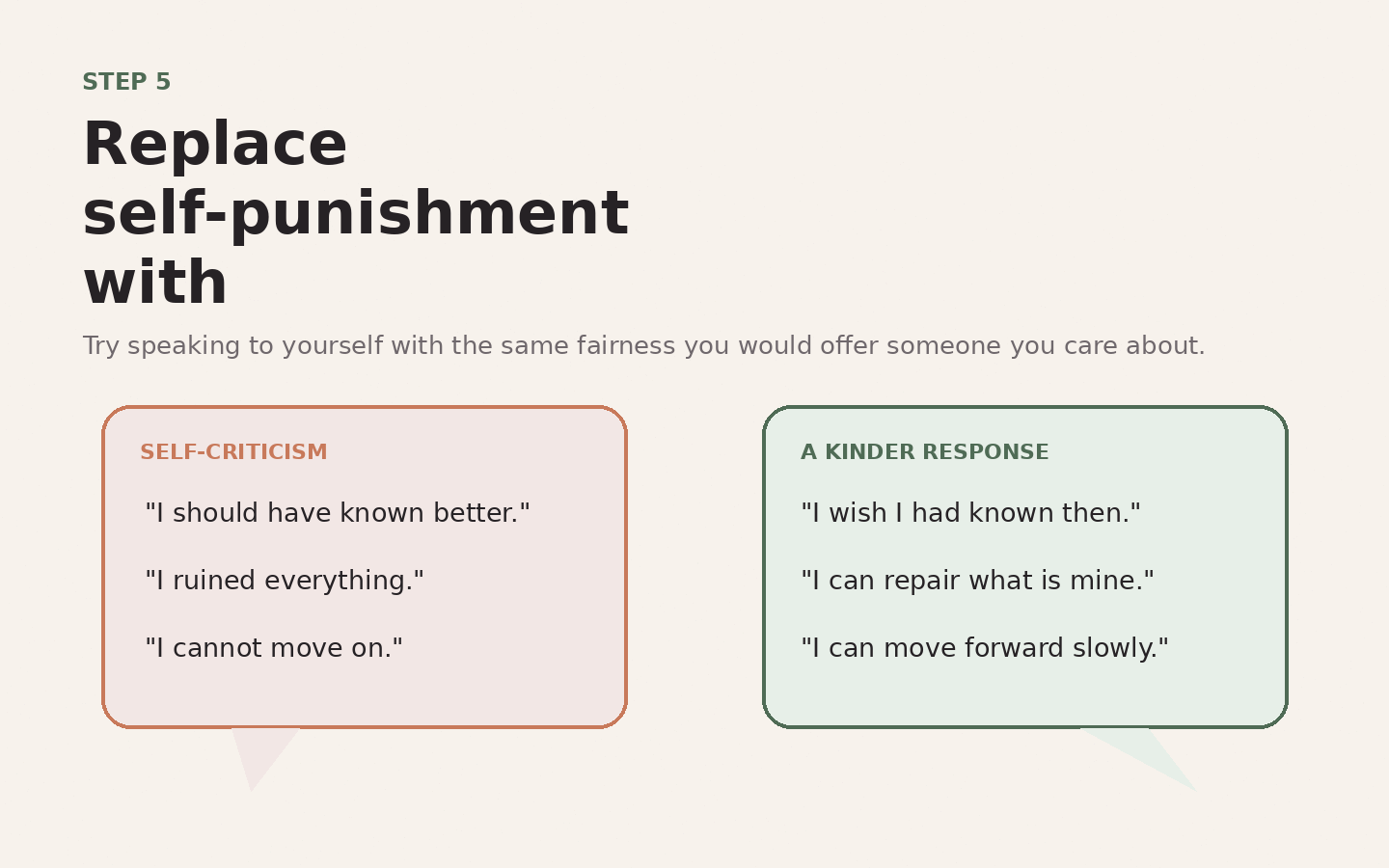
5. Replace self-punishment with self-compassion
Regret often turns into self-attack: “I was so stupid,” “I ruin everything,” or “I should have known better.” This can make accountability harder, not easier, because the focus shifts from what you did to a global judgment about who you are.
Try a more accurate response:
- “I wish I had handled that differently.”
- “I can take responsibility without insulting myself.”
- “I know more now than I did then.”
Self-compassion does not mean letting yourself off the hook. It means responding to your own pain and mistakes with less hostility. A 2025 systematic review found that repetitive negative thinking, including worry and rumination, was one of the most studied processes linking self-compassion with psychological outcomes; the authors also noted that much of the evidence was cross-sectional, so the relationship should not be treated as a simple cause-and-effect rule. [5]
A small randomized study with female college students also found that a brief self-compassion program reduced rumination more than an active time-management comparison. The sample was limited, but it supports the idea that a kinder inner response can be practiced rather than left to chance. [6]
6. Create some distance from reminders that keep reopening the same loop
You do not have to keep every reminder within easy reach while you are trying to move forward. Re-reading old messages, checking an ex-partner’s social media, revisiting photos, or repeatedly asking mutual friends for updates can pull you back into the same emotional cycle.
Choose distance that is intentional rather than dramatic. You might archive a message thread, mute an account for a month, place old photos in a folder you do not see every day, or ask a friend not to bring up a certain person unless there is a practical reason.
This is not a rule that you must avoid reminders forever. It is a temporary boundary around your attention. You can decide later what you want to keep, revisit, or release.
If a reminder is part of ordinary life, such as seeing a former partner at school, work, or family events, focus on reducing unnecessary exposure rather than trying to control every encounter.
7. Take one repair step when something is still yours to address
Sometimes letting go is difficult because there really is unfinished business. If you harmed someone, left something unresolved, or broke a commitment, one responsible action may help you stop turning the same issue over in your head.
A repair step could be an apology, repayment, correction, returned item, or honest clarification. Keep it focused on what is yours.
For example:
“I have been thinking about how I spoke to you. It was unfair, and I am sorry. I do not expect you to respond, but I wanted to take responsibility.”
A sincere repair does not require the other person to forgive you, reopen the relationship, or make you feel better. Their response remains theirs. Your responsibility is to act with as much integrity as you can now.
If reaching out would violate a boundary, reopen harmful contact, or create pressure for the other person, choose a private form of accountability instead. Write what you wish you had done differently and make the changed behavior visible in your future choices.
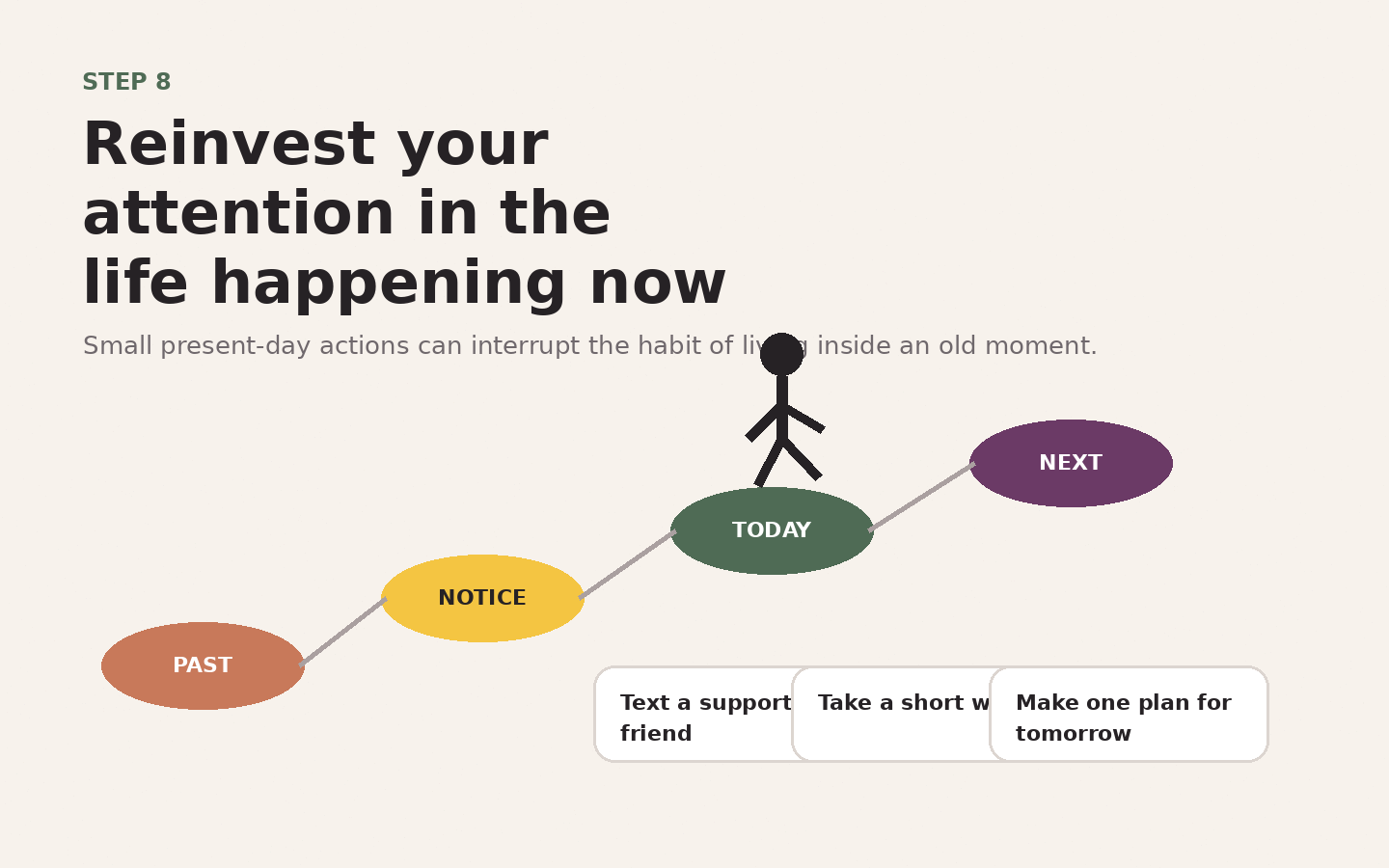
8. Reinvest your attention in the life happening now
The past tends to feel larger when it becomes the main place your attention goes. Moving forward requires giving the present something real to compete with it.
Choose small actions rather than demanding a major reinvention. Call someone who makes you feel grounded. Cook dinner without scrolling through old messages. Take a short walk. Return to a hobby. Make one plan for the weekend. Spend time with people who know you as you are now, not only as you were during the painful chapter.
Values can help when you are unsure where to place your energy. Ask: “What kind of person do I want to be in my relationships now?” You may choose to practice honesty, steadiness, courage, kindness, or clearer boundaries.
Psychological flexibility research emphasizes committed action in the direction of personally meaningful values, even when difficult thoughts and feelings are still present. [4] You do not need to feel completely free of the past before you begin participating in the present.
9. Get support if the past keeps controlling the present
Some memories loosen with time, reflection, boundaries, and new experiences. Others remain intense and begin affecting sleep, relationships, concentration, mood, or your sense of safety.
If you keep returning to the same event despite trying to move forward, consider speaking with an appropriately licensed mental-health professional. Support can be especially useful when the past involves trauma, grief, persistent anxiety, depression, or patterns that are difficult to change on your own.
You do not need to prove that the experience was “bad enough” before asking for help. The practical question is how much it is interfering with your life now.
If you ever feel at risk of harming yourself or someone else, seek urgent local help or emergency support rather than relying on self-help strategies alone.
A simple check-in when the past comes back
You will probably think about the past again. That does not mean you have failed to let go. Memories can return even when you are making meaningful progress.
When one appears, try this quick check:
- What am I feeling right now?
- Is there anything useful I can do about this today?
- Have I already learned what I can from this?
- What deserves my attention in the next hour?
If there is an action, take or schedule it. If there is no action, acknowledge the thought and come back to what is in front of you. The aim is not perfect control over your mind. It is a more deliberate response when an old story asks for your attention again.
Frequently Asked Questions
How long does it take to let go of the past?
There is no fixed timeline. A minor regret may soften quickly, while a major loss, betrayal, or life change can take much longer. Look for changes in how you respond rather than waiting for the memory to disappear. You may still think about what happened but spend less time replaying it, recover more quickly after reminders, or make choices that are less controlled by the past.
Does letting go mean I have to forgive someone?
No. Letting go and forgiveness are not the same decision. You can reduce the amount of attention you give an old hurt, protect yourself with boundaries, and move forward without restoring trust or offering forgiveness. If forgiveness matters to you personally, it can be considered separately and on your own terms.
Why do I still think about something that happened years ago?
Time alone does not decide which memories stay emotionally active. An event may still connect to regret, unanswered questions, shame, grief, or a belief you continue to hold about yourself. Instead of judging the age of the memory, ask what keeps it relevant now. That answer can point toward a more useful next step.
How do I let go when I still have to see the person?
Focus on boundaries you can maintain in real life. Keep necessary contact brief and respectful, decide which topics are off-limits, and avoid using every interaction to revisit the history. Afterward, return to your own routines and relationships rather than analyzing every word. If the situation feels unsafe or highly distressing, professional guidance can help you plan boundaries that fit your circumstances.
You do not have to erase the past
Moving forward does not require you to make the past meaningless. You can keep the lesson, acknowledge the hurt, repair what is yours, and still decide that the old moment will not receive all of today’s attention.
Start with one step that fits where you are now. Often, letting go becomes less about one final decision and more about repeatedly choosing where you want to place your attention next.
Sources
- Watkins, E. R., & Roberts, H. (2020). Reflecting on rumination: Consequences, causes, mechanisms and treatment of rumination. Behaviour Research and Therapy, 127, 103573.
- NHS, Every Mind Matters. Problem solving.
- NHS, Every Mind Matters. Tackling your worries.
- Macri, J. A., & Rogge, R. D. (2024). Examining domains of psychological flexibility and inflexibility as treatment mechanisms in acceptance and commitment therapy: A comprehensive systematic and meta-analytic review. Clinical Psychology Review, 110, 102432.
- Wiese, C. W., et al. (2025). The mechanisms underlying the relationship between self-compassion and psychological outcomes in adult populations: A systematic review.
- Smeets, E., Neff, K., Alberts, H., & Peters, M. (2014). Meeting suffering with kindness: Effects of a brief self-compassion intervention for female college students. Journal of Clinical Psychology, 70(9), 794–807.